
 Village Connect
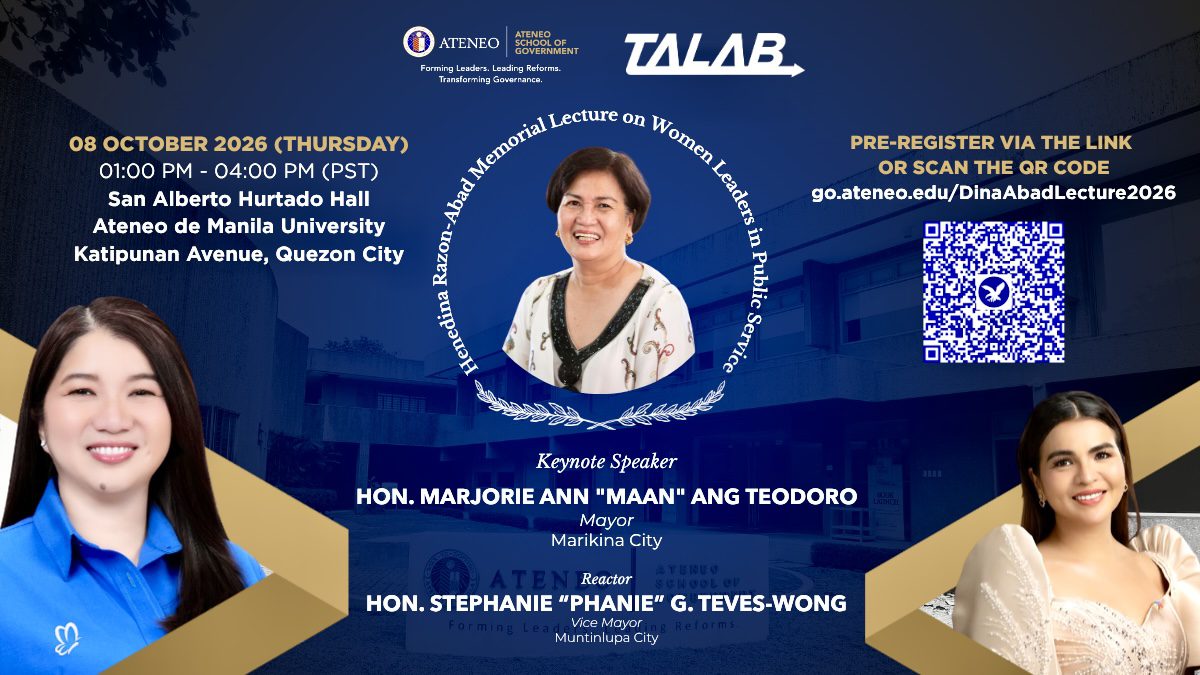
Good governance begins with understanding the everyday needs of the people, a principle that Marikina City Mayor Maan Teodoro highlighted as she shared her administration’s people-first leadership philosophy during a prestigious lecture at Ateneo de Manila University.
Speaking at the Second Henedina Razon-Abad Memorial Lecture on Women Leaders in Public Service, Teodoro emphasized how compassion, accountability, and community engagement can transform local governance and strengthen public trust.
The event, organized by the Ateneo School of Government (ASOG), took place at the university’s San Alberto Hurtado Hall in Quezon City as part of ASOG’s 25th anniversary celebration and the annual Talakayang Alay sa Bayan (TALAB).
At the heart of Teodoro’s presentation was “Alagang Marikina City,” a governance philosophy centered on providing meaningful public services while anticipating the changing needs of residents.
Rather than viewing government responsibilities solely through policies and programs, Teodoro encouraged public officials to recognize the human experiences behind every decision.
“People should see that government is working for them and they can depend on it,” she said.
Drawing from her experience as Marikina’s former 1st District representative and now city mayor, Teodoro explained that effective leadership requires personal commitment and genuine concern for communities.
She introduced four dimensions of alaga, or care, beginning with oneself and extending to family, community, and ultimately public service.
According to Teodoro, these interconnected responsibilities form the foundation of leadership that places people’s welfare above political considerations.
“Ang patunay ng Alagang Marikina City ay nakaukit sa puso at alaala ng bawat taga-Marikina,” she said, emphasizing that residents should experience government assistance through concrete actions.
Building a More Resilient City
Marikina’s governance initiatives have also attracted national attention, particularly its approach to environmental sustainability and disaster preparedness.
President Ferdinand Marcos Jr. previously recognized the city’s integrated flood-management and waste-recycling programs during an inspection of the Marikina River Linear Park and Centralized Materials Recovery Facility.
The initiatives demonstrate how environmental protection, waste recovery, and flood prevention can work together to improve urban resilience.
Marikina’s circular economy approach encourages recovering and reusing materials instead of relying exclusively on conventional garbage disposal.
Residents have likewise acknowledged improvements in the city’s flood-response capabilities compared with the devastating impact of Typhoon Ondoy in 2009.
Inspiring Future Public Leaders
Beyond presenting Marikina’s accomplishments, Teodoro challenged fellow leaders to consider how government decisions affect ordinary citizens.
“The city I once dreamed of as a child is the city I am now helping build as mayor,” she shared.
She urged policymakers to prioritize the experiences of residents when allocating resources, improving services, and addressing unfinished community concerns.
Established in October 2025, the memorial lecture honors Henedina “Dina” Razon-Abad, founding dean of ASOG and a respected advocate of participatory, transparent, and accountable governance.
Attended by government officials, academics, students, and civil society representatives, the gathering highlighted the growing influence of women in shaping responsive public institutions.
For Teodoro, the message was clear: meaningful leadership is measured not simply by completed projects, but by the trust, security, and dignity that government brings to people’s lives.


Loading…