
 Village Connect
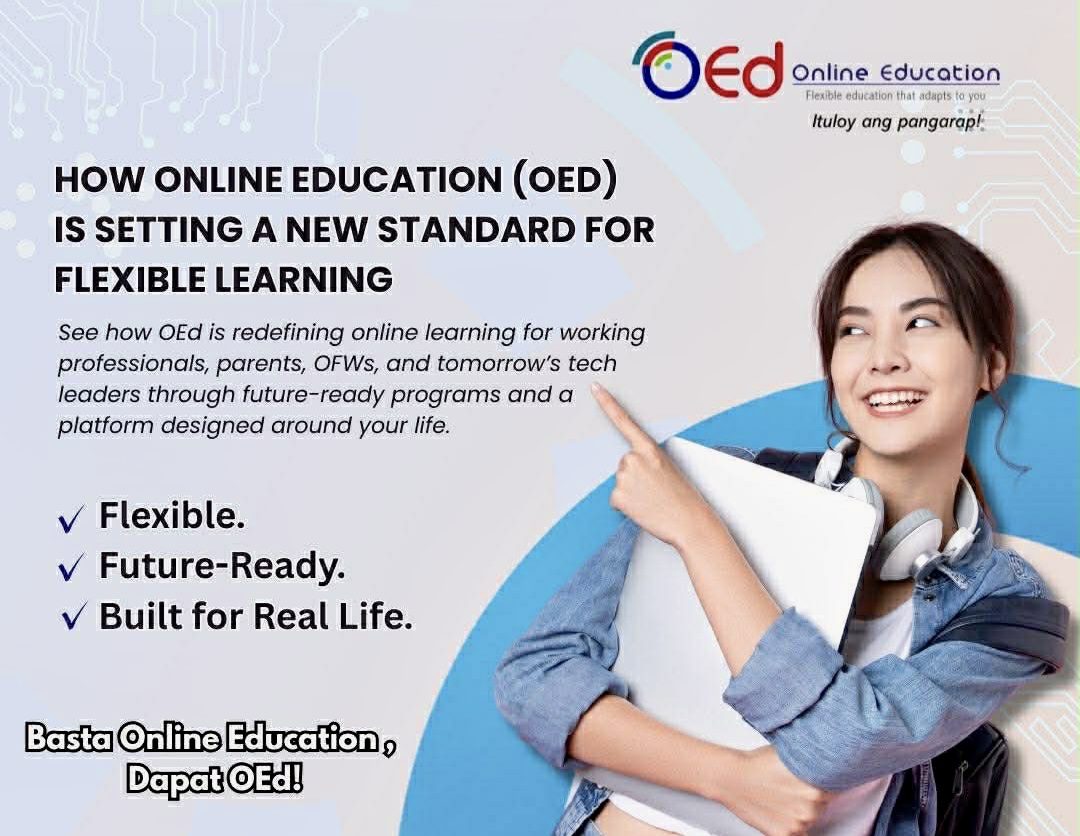
In a world where time has become one of the most valuable resources, education is quietly undergoing a transformation—one that challenges long-standing assumptions about how, when, and where learning should happen. At the center of this shift is Online Education (OEd), an institution that has spent more than a decade redefining what flexibility truly means for modern learners.
For many schools, flexibility has often meant adapting traditional systems—moving lectures online or offering hybrid schedules. But for OEd, the idea runs much deeper. It is not about adjusting the old model; it is about building an entirely new one from the ground up. Since 2015, OEd has focused on creating a fully digital learning environment designed specifically for people whose lives do not follow a fixed routine—working professionals, parents, entrepreneurs, and overseas Filipinos striving to complete their education while balancing real-world responsibilities.
This distinction is what sets OEd apart. Instead of asking students to adjust their lives around school, OEd reshapes education to fit into the rhythm of everyday life. Whether it’s reviewing lessons after a night shift, studying once children are asleep, or attending classes from another time zone, the platform enables learning to happen when it is most practical.
At the surface level, the experience appears straightforward: a digital portal where lectures, assignments, and assessments are readily accessible. But behind that simplicity lies a carefully designed ecosystem. OEd’s integrated learning management system allows students to track their progress, submit requirements, attend virtual sessions, and communicate with mentors—all within a single platform. Every feature is built with one goal in mind: to remove barriers, not create them.
Yet what truly defines OEd is not just its technology, but the support that surrounds it. In an increasingly competitive online education space, many institutions focus on enrollment numbers. OEd, by contrast, emphasizes guidance. From the moment a student inquires, academic advisers step in to help map out a path—offering practical advice on course selection, workload management, and efficient completion strategies.
This human element transforms the experience. It turns what could be an isolated digital journey into a supported, structured process. For students navigating work, family, and personal commitments, that kind of guidance can make the difference between starting a degree and actually finishing it.
OEd’s approach also reflects a broader evolution in the kind of programs available online. No longer limited to general or simplified courses, students today can pursue specialized, future-focused fields. Among the most notable is the Bachelor of Science in Artificial Intelligence (BS AI), a program that signals where both education and industry are headed.
Through this offering, students gain exposure to areas such as machine learning, robotics, natural language processing, and ethical AI—disciplines that are rapidly shaping global industries. More importantly, the program demonstrates that even highly technical and advanced subjects can be delivered effectively through a fully online platform, without compromising accessibility.
This is where OEd’s long-term investment in digital infrastructure becomes evident. Unlike institutions that retrofitted traditional systems for online use, OEd was designed from the outset for distance learning. Every process—from enrollment to document requests—is streamlined to minimize friction, ensuring that students can focus on learning rather than logistics.
The impact of this model is far-reaching. For a call center agent working overnight shifts, it means continuing education without sacrificing income. For a parent, it means building a future without stepping away from family. For an overseas Filipino, it means earning a degree without returning home. In each case, education becomes not a disruption, but an extension of life.
As more institutions enter the online education space, the language of flexibility has become increasingly common. But OEd continues to draw a clear line between promise and practice. True flexibility, it argues, is not defined by marketing claims or occasional online sessions. It is defined by systems that genuinely understand and adapt to the realities students face every day.
After years of refinement, OEd has established itself not just as a provider of online courses, but as a partner in educational completion. Its strength lies in experience—years spent listening to students, improving systems, and building a culture centered on support and accessibility.
In the end, the future of education is no longer a distant concept. It is already taking shape in platforms like OEd—quietly, steadily, and purposefully. And as more learners seek pathways that align with their lives, one thing becomes clear: the true measure of flexibility is not how education changes its format, but how well it understands the people it serves.


Loading…